
In a world facing rising living costs, climate pressures and increasingly defined by overconsumption and waste, a quiet revolution is taking place. One that challenges the very idea of “throwaway culture.”
As Laura Fogg-Rogers, Associate Professor of Engineering in Society at UWE Bristol, opened the event, she captured the irony perfectly:
“So waste is not the most glamorous of subjects but it’s brought out one of our largest crowds. So clearly everyone is very interested in it!”
– Laura Fogg-Rogers, Associate Professor of Engineering in Society at UWE Bristol
That interest reflects a growing awareness: waste is no longer just a background issue, it’s central to how we live, consume and build communities.
Rethinking Waste: A Cultural Shift
Our current system has long relied on a flawed assumption that resources are infinite and disposal is effortless.
As Laura Fogg-Rogers explained: “Our current economy conceives that there’s endless magic stuff that can just be dug up somewhere. We’ll use it and then it endlessly, magically disappears somewhere as well. And we know that’s not the case… So, we really have to be thinking what are we doing with digging all this stuff and where is it going? We need another way to meet both human needs but also environmental physical reality as well. So, one such vision is the circular economy.”
That “other way” is increasingly understood through the work of the Ellen MacArthur Foundation, which defines it as: “A system where materials never become waste and nature is regenerated. In a circular economy, products and materials are kept in circulation through processes like maintenance, reuse, repair, refurbishment, remanufacture, recycling and composting.”
As Laura Fogg-Rogers added, grounding the discussion locally: “That’s what we are going to talk about today, about what does that look like in reality here in Bristol and surrounding areas as well.”
From Waste to Resource
One of the most powerful shifts discussed in the event is conceptual: moving from “waste” to “resource.”
“We were putting 95% of our waste to landfill back in the 80s, would you believe?
– Andy Street, Chair of FareShare South West and Feeding Bristol
Andy Street, Chair of FareShare South West and Feeding Bristol, highlighted how far we’ve come – from a time when most waste went to landfill to a growing recognition of its potential value – emphasising that, “There’s very little that goes into our bins that can’t be used in some way.”
This reframing is critical. When we stop seeing discarded items as useless, we unlock new systems of value – economic, environmental and social.
The Circular Economy in Action
At the heart of the discussion is the idea of the circular economy: a model that replaces the traditional “take–make–waste” system with one where resources are kept in use for as long as possible.
Rather than throwing things away, the circular approach encourages:
- Repairing broken items
- Sharing underused resources
- Reusing materials in new ways
- Redistributing surplus (especially food)
This isn’t just about recycling, it’s about redesigning how we live, consume and connect.
Communities as Catalysts for Change
One of the strongest messages from the talk is that real change happens locally.
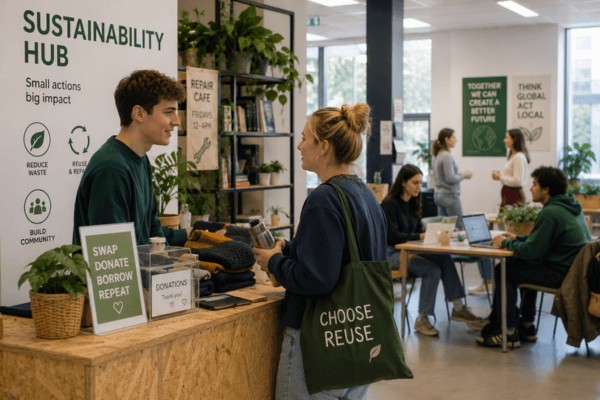
Community-led initiatives, such as repair cafés, tool libraries and food redistribution networks, are proving that sustainability doesn’t have to be top-down.
These grassroots efforts:
- Build practical skills (fixing, mending, repurposing)
- Strengthen social ties
- Create inclusive spaces for collaboration
- Help people cope with financial pressures
In other words, sustainability becomes a shared experience, not an individual burden.
Sharing, Connection and Community
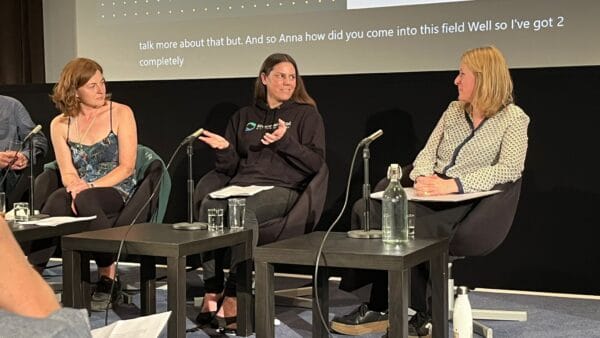
“We’re talking about that personal connection. It’s that local connection. It’s getting pleasure from giving away the things that we don’t need ourselves.”
– Anna Perry, Chair at Share Bristol
For Anna Perry, Chair at Share Bristol, the solution is as much cultural and emotional as it is practical, reflecting on shifting habits and attitudes, she explained that focus should be centred on “help[ing] people find joy and community connection in how they dispose of things they don’t want anymore.”
She continued to highlight that much of what we consider “ours” is simply underused potential, explaining, “there’s so much in people’s houses that we lock away… [that] would have so much more of a useful life and a purpose if it was used by the community.”
Her point underscores something deeper: circularity isn’t just about systems, it’s about behaviour, habits and meaning.
The Rise of the Access Economy
A key part of this shift is moving away from ownership altogether.
As Anna Perry explained: “The access economy is thinking about how people get access to things even without owning them and so we are used to book libraries, we’re used to car hire, we’re used to suit hire for weddings and things like that but increasingly that is coming into other aspects of our lives with car sharing clubs and scooter and bike hire – so the community has access to things they need, whether or not they can afford to buy them outright or pay a commercial hire fee, or even if they’ve got space to store them in their houses or not – and so thinking about the sharing economy [or] access economy… is another step forward.”
This model not only reduces waste, it increases equity, making goods and services accessible to more people.
Shaping Habits for the Future
A key strategic insight from the discussion is the importance of early habit formation.
As Anna Perry drew attention to, initiatives like Share Bristol’s Library of Things on the UWE Frenchay campus aim to embed borrowing and community-minded behaviours in young people, recognising that habits formed between 18 and 22 can last a lifetime. Universities, therefore, act as testing grounds for more sustainable ways of living. Supporting this, Laura Fogg-Rogers noted that campus initiatives such as sustainability hubs are already creating “our own little ecosystem” where students can share and reuse resources.
Final Thoughts: Waste as Opportunity
The message of the event is clear: waste is not inevitable. From repair and reuse to sharing and access, communities are already building alternatives that are more sustainable, more connected and more human.
What emerges is not just a new system, but a new mindset: one that sees value where we once saw disposal and opportunity where we once saw waste. We need to encourage a shift from being passive consumers to active participants in a shared economy.
The “Waste to Worth” presentation drives home an important idea: tackling global challenges doesn’t always require complex solutions. Sometimes, it starts with something as simple as fixing a broken toaster, sharing a tool or redistributing leftover food.
Individually, these actions may seem small. Together, they form the foundation of a more sustainable, connected and resilient society.
And as this growing movement shows, the transition doesn’t start with systems alone: it starts with people, places and the choices we make every day.